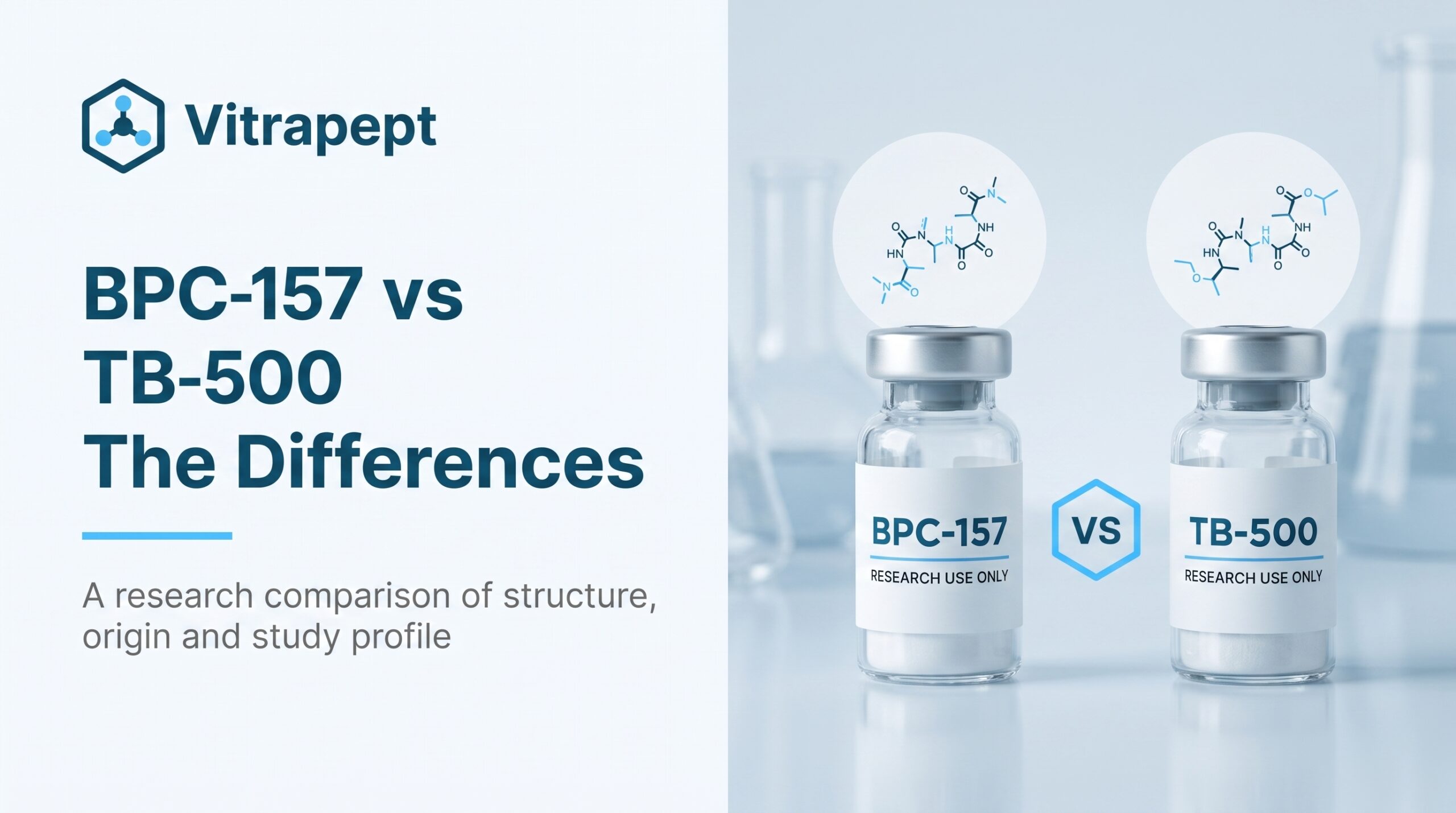
BPC-157 and TB-500 are two of the most frequently requested research peptides, and they are often mentioned together because both appear in the scientific literature on tissue-repair models. Despite the overlap, they are distinct compounds with different structures, origins, and research profiles. This research-focused comparison lays out how BPC-157 and TB-500 differ and why they are sometimes studied side by side.
What is BPC-157?
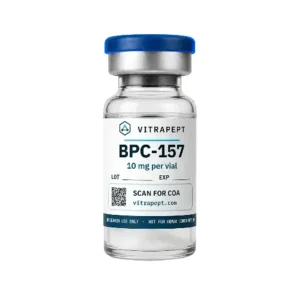
BPC-157 (Body Protection Compound-157) is a synthetic pentadecapeptide — a chain of 15 amino acids — derived from a sequence identified in gastric juice. In published research it has been studied primarily in models of tendon, ligament, and gastrointestinal tissue, where investigators examine its effects on cellular repair pathways.
Key characteristics reported in the literature include notable stability and a relatively small, well-defined structure, which makes it a common subject in laboratory research into localized tissue processes.
What is TB-500?
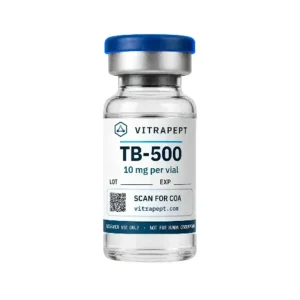
TB-500 is a synthetic peptide fragment related to thymosin beta-4 (Tβ4), a naturally occurring protein involved in cell migration and regulation of actin, a building block of the cytoskeleton. TB-500 corresponds to the active region of that larger protein.
Because thymosin beta-4 is associated with cell movement and tissue organization, TB-500 tends to appear in research contexts examining broader, more systemic repair and migration processes rather than a single localized site.
BPC-157 vs TB-500: side-by-side
| Attribute | BPC-157 | TB-500 |
|---|---|---|
| Type | Synthetic pentadecapeptide (15 amino acids) | Synthetic fragment of thymosin beta-4 |
| Origin | Sequence derived from gastric juice | Derived from a naturally occurring regulatory protein |
| Common research focus | Localized tendon, ligament & gut models | Systemic cell migration & tissue organization |
| Structure | Small, well-defined, notably stable | Fragment representing an active protein region |
Why they’re often studied together
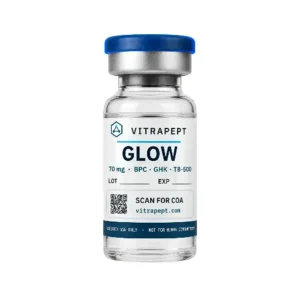
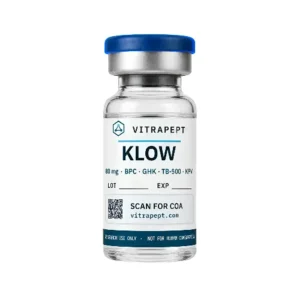
Because BPC-157 is associated with localized repair models and TB-500 with more systemic migration processes, researchers sometimes examine them together to explore complementary pathways. This is why blended research products — such as our TB500 + BPC-157 stack — exist: they allow both compounds to be studied from a single, batch-tested vial with one certificate of analysis.
What matters more than the comparison: verification
Whichever compound a research protocol calls for, the decisive factor is purity and identity. A peptide is only as reliable as its certificate of analysis. Before comparing research profiles, confirm that the vial contains what the label claims — check the HPLC purity, mass-spectrometry identity, and batch number. Our guide on how to read a certificate of analysis walks through exactly that.
Explore lab-tested BPC-157 and TB-500
Both compounds are available third-party tested, with a certificate of analysis on every batch. Compare BPC-157 and TB-500 individually, explore the combined TB500 + BPC-157 stack, or browse the full Healing & Recovery range. When you’re ready to work with a vial, the free reconstitution calculator handles the concentration math.
All Vitrapept products are intended strictly for laboratory and research purposes only. They are not for human or animal consumption, and nothing in this article is medical advice. Statements have not been evaluated by the EMA or FDA.